
Tom Stoppard's Metaphysical Comedy
A tribute to the playwright who died late last year

You have received this email because you subscribed to THE COMIC MUSE, the Substack of novelist, dramatist, and philosopher Daniel McInerny. Find out more about me here.
Most of my writing on THE COMIC MUSE is already free for subscribers, and I am currently in the midst of taking the rest of it out from behind the paywall. If you find yourself moved to support my work here, that would be grand. But it is not necessary. I hope you will enjoy my essays, reviews, short fiction, and poetry.
Today’s piece is on the late Tom Stoppard, widely regarded as the greatest playwright of his era. I hope you enjoy it.
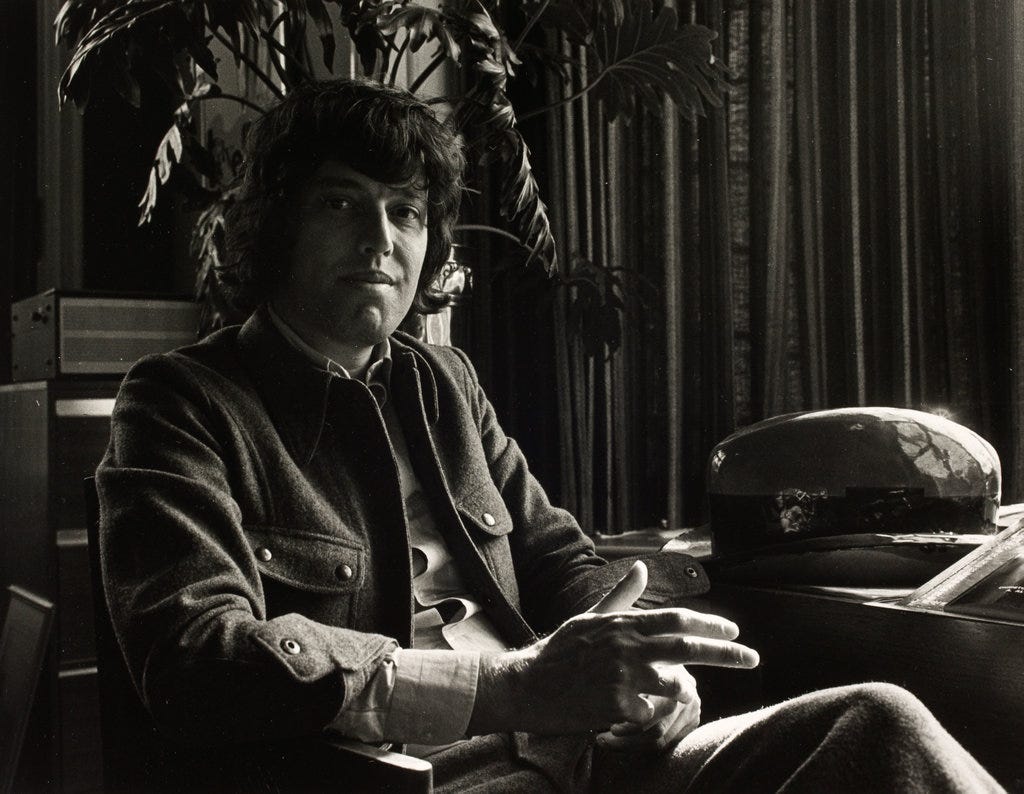
Although there are few of his works that I admire without qualification, sometimes severe, Tom Stoppard, who died last November 29, aged 88, has long appeared on my list of favorite writers. He deserves one of my personal palms if only for this early statement of his career aims as a playwright:
“My objective has always been to perform a marriage between a play of ideas and a farce. As to whether this is a desirable objective, I have no idea. It represents two sides of my own personality, which can be described as seriousness compromised by frivolity , or…frivolity redeemed by my seriousness.
G.K. Chesterton, in an essay on theatre, says that, whatever else it may be, the theatre must be a “treat.” Stoppard, whatever else he may have brought to the art of drama—and he brought plenty—understood this. If the theatre, if art, doesn’t make us laugh, or in some other way excite or surprise—if, in the end, it isn’t a treat (which is not at all the same as being superficial)—then what’s the point?
“There’s a deep suspicion among serious people of comic situations,” Stoppard maintained early in his career. “The point is that good fun is merely frivolous….I want to demonstrate that I can make serious points by flinging a custard pie around the stage for a couple of hours….My line at the moment would be to try to reduce weighty preoccupations about the way the world is going to an extended exchange of epigrams with a good first-act curtain.”
As his career progressed, Stoppard moved away from pure farce into more dramatic comedy, but the desire to perform a marriage of wit and the search for wisdom never left him.
We live in an age desperately in need of many things, not least of philosophy. Above all we need a philosophical anthropology, a true understanding of what we are as human persons that includes an account of the immaterial dimension of our existence, especially our yearning for the source and destiny of that dimension.
Talk like this tends to cause even one’s friends to lurch suddenly towards the bar. Our culture is allergic to abstract ideas pursued with any kind of rigor. A Socrates would be no more successful with us than he was with the ancient Athenians. But if we could, somehow, perform a marriage, so to speak, between Socrates and, say, the comic drama of an Aristophanes, might we not have a chance of touching the hearts and minds of a broad audience with the spirit of philosophy? Stoppard’s version of this marriage of dramatic comedy and ideas might not have been perfect, but his pursuit of the ideal, especially his exploration of the metaphysical dimension of our predicament as human beings, is itself worthy of our attention.
“Comedy and tragedy are concerned with morality, that is our relations under God, drama with man in society,” says the playwright David Mamet (an admirer of Stoppard’s). “The theatre exists to present a contest between good and evil. In both comedy and tragedy, good wins. In drama, it’s a tie.”
Stoppard’s work restores this classical understanding of comedy. The human drama is pursued within the wider theo-drama, and its comic aspect is attained not only in a social resolution—traditionally, a marriage; for Stoppard, a conception of love essentially Romantic in character, as channeled through the sexual revolt of the 60s—but also with good “winning” in metaphysical terms.
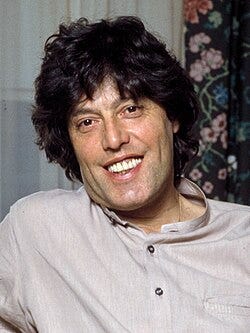
Challenging the Mainstream Orthodoxy
In the play that brought Stoppard to international attention, Rosencrantz and Guildenstern Are Dead (1966), the events of Shakespeare’s Hamlet are depicted from the point of view of two friends of the prince enlisted by the king and queen to spy on the kingdom’s strangely moody heir. The two hapless courtiers never quite discover what story they are in before they are, as in Shakespeare’s play, grimly dispatched. It is a play of bewildered, inept inquiry. Proper philosophy has not yet begun.
“The play had no substance beyond its own terms, beyond its apparent situation,” said Stoppard in an interview. “It was about two courtiers in a Danish castle. Two nonentities surrounded by intrigue, given very little information and much of that false. It had nothing to do with the condition of modern man or the decline of metaphysics. One wasn’t thinking, ‘Life is an anteroom in which one has to kill time.’ Or I wasn’t, at any rate.”
Things change with Jumpers (1972), a play about the antics of moral philosophers within a send-up of a locked-room murder mystery. “What the play says—and this is going to sound turgid in print—is that if the status of goodness is a matter of convenience and social evolution, then it is open to be changed into a reverse direction where casual murder might be deemed good.” In the play, Stoppard probes the absurdum in this reductio in one of the funniest exchanges in all his works. A detective named Bones arrives to investigate the murder of a philosopher, and asks George, the philosopher who is the protagonist of the play, to tell him something about another philosopher at the party where the murder took place, a man named McFee. Regarding McFee George replies:
GEORGE: A very good man in his way, though perhaps I should describe him as generally approved of—he doesn’t, of course, believe in good and bad as such.
BONES: Really? How do you mean?
GEORGE: He thinks good and bad aren’t actually good and bad in any absolute or metaphysical sense. He believes them to be categories of our own making, social and psychological conventions….but the point is it allows him to conclude that telling lies is not sinful but simply anti-social.
BONES: And murder?
GEORGE: And murder, too, yes.
BONES: He thinks there’s nothing wrong with killing people?
GEORGE: Well, put like that, of course… But philosophically, he doesn’t think it’s actually, inherently wrong in itself, no.
BONES (Amazed): What sort of philosophy is that?
GEORGE: Mainstream, I’d call it. Orthodox mainstream.
(BONES scratches his head. GEORGE gazes at him innocently.)
The more one knows the arguments of contemporary moral philosophy, the funnier, and more deadly accurate, this exchange becomes. Stoppard rightly spoofs the great silliness in philosophers attempting to concoct impersonal rational justifications for what is essentially an exercise of power. Goodness cannot be reduced to convenience and social evolution.
The murder mystery in Jumpers disrupts George’s hilarious attempts to prepare a prestigious lecture in which he attempts to prove the existence of God. This is the first indication that, for Stoppard, the human comedy must be established by a divine intelligence. In an interview about Jumpers he remarked: “I’ve always thought that the idea of God is absolutely preposterous, but slightly more plausible than the alternative proposition that, given enough time, some green slime could write Shakespeare’s sonnets.”
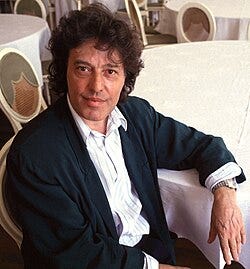
Interim: Et in Arcadia Ego
Twenty years later, in Arcadia (1993), which many regard as his finest achievement, Stoppard explores the orthodox mainstream on another of its fronts: the nature of the universe. Arcadia is an elegantly constructed play with dual timeframes, one in the 19th , the other in the 20th century. It is a heady mixture of mathematics, cosmology, and the antithesis between the Classical and the Romantic temperaments. Stoppard’s chief interest in Arcadia is modernity’s claim that the universe is a perfectly comprehensible complex of material interactions—the “action of bodies in heat” to quote a character from the play—that is wholly and completely determined. But with this tragic twist: the universe may be a kind of clock, as Newton imagined, but it is a clock that is winding down. The Second Law of Thermodynamics identifies the entropy that upsets the order of the universe. The heat released in all those material interactions cannot be recaptured. Equilibrium—the coldness of a corpse—is our fate.
The metaphor for entropy in Arcadia is sexual attraction, “the attraction that Newton left out.” As the character Chloë says: “The universe is deterministic all right, just like Newton said, I mean it’s trying to be, but the only thing going wrong is people fancying people who aren’t supposed to be in that part of the plan.” Sex for Stoppard is the chaos principle. His plays often display a, not just bawdy, but reckless sexuality, with a particular emphasis upon marital infidelity.
Yet there is also, at times, an aspiration for a more mature form of love. The final image of Arcadia shows the rakish tutor Septimus Hodge honoring the sexual innocence of the young woman he has fallen in love with, his pupil Thomasina Coverly. Their final waltz in the 19th-century timeframe seems to honor the abiding goodness of marriage and fidelity. And yet, as the audience has been forewarned by the 20th-century plot, that very night Thomasina will be killed in a fire—a fire she seems unwittingly to start. The heat of chaos sends everything to its doom.
If Arcadia were Stoppard’s final assessment of the prospects of transcendent goodness in the universe, he would be at best only a tragicomic playwright. An updated Samuel Beckett, with a hat-tip to George Bernard Shaw and Oscar Wilde. But in his penultimate play, The Hard Problem (2015), Stoppard takes up the metaphysical question once more, and this time decides in the affirmative. And in doing so, he offers us the most intellectually important play of the 21st century thus far. It is not Stoppard’s funniest play (though there are many good lines), but it is certainly his most successful play in philosophical terms.

What Explains Human Consciousness?
The Hard Problem is about a young brain scientist named Hilary who is onto the search for something beyond determinism. Like so many of Stoppard’s characters, Hilary is impetuous in her sexual behavior. For a woman who became pregnant at fifteen and prays nightly for the daughter she gave up for adoption, sex for her remains a mere material interaction in which the heat quickly dissipates. Yet Hilary may still be the most interesting protagonist invented by Stoppard. She mirrors George in Jumpers for leaning into a transcendent notion of goodness and the possibility of God’s existence. In Jumpers, George contends against a reduction of “good” to social convention. In The Hard Problem, Hilary contends against a reduction of “good” to enlightened self-interest—the determinist’s preferred explanation of all human behavior. This leads Hilary to the “hard problem,” the problem of human consciousness, the one problem even determinists have trouble solving. In a debate with two other neuroscientists, Hilary makes her case, which ends with a devastating rejoinder:
LEO: But can a computer do what a brain can do?
AMAL: Are you kidding?—A brain doesn’t even come close.
LEO (to Hilary): Do you want to jump in?
HILARY: Not much.
LEO: Really? Why?
HILARY: It’s not deep. If that’s thinking. An adding machine on speed. A two-way switch with a memory. Why wouldn’t it play chess? But when it’s me to move, is the computer thoughtful or is it sitting there like a toaster? It’s sitting there like a toaster.
LEO: So, what would be your idea of deep?
HILARY: A computer that minds losing.
When Amal insists that there is overwhelming evidence that the brain causes consciousness, Hilary counters: “There is overwhelming evidence that brain activity correlates with consciousness. Registers consciousness. Nobody’s got anywhere trying to show how the brain causes consciousness.”
For Hilary, consciousness is an immaterial reality, one that can only be explained by an overarching consciousness, a being commonly referred to as God. In an episode that calls back the main theme of Jumpers, Hilary faces off with Spike, her former tutor and lover. Spike argues: “But it’s pathetic to rely on a supreme being to underwrite what you call your values. Why are you afraid of making your own?” Hilary’s response reaches the following crescendo:
HILARY: But there are things we believe are right or wrong like, say, cruelty, and if this belief is a brain-state, that’s fine by me, but our brain-state is about something, it’s about cruelty, which is right or wrong whether we’re thinking about it or not.
SPIKE: You don’t need God for that.
HILARY (forcefully): But you need something for it to be true, some kind of overall moral intelligence, otherwise we’re just marking our own homework. That’s what I pray to for Catherine, because somewhere between ape-men and the beginning of religion, we became aware of an enormous fact we didn’t understand.
Catherine is Hilary’s daughter, and as the play reveals in its climax, that overall moral intelligence hears Hilary’s prayers for Catherine and proves the abiding goodness both of Hilary’s selfless mother love for her daughter and of God.
The Final Curtain
Stoppard’s last stage play, Leopoldstadt (2020), is a moving meditation on antisemitism and the horrors of the Holocaust. It is Stoppard’s most personal play, as in it he comes to terms with the evils visited upon his own Jewish ancestors. The play does not ask metaphysical questions in any direct way, though the problem of evil provides a troubling backdrop to the action. The Jewish families he depicts—in a period stretching from 1899 to 1955—are intent on assimilation, culture, and, awfully and finally, survival and remembrance. Religion is important as a matter of culture and as a vehicle for assimilation.
The play opens with the Merz family in 1899 celebrating Christmas. Its patriarch, Hermann, is a Catholic convert. However perennially relevant to recall the barbarism of the Nazi bloodlust for the Jews, the play also rings an equally heartbreaking note in presenting Judaism and Catholicism, not as addresses to the overall moral intelligence, but as mere cultural or ethnic apparel. It is ambiguous whether Leopoldstadt upholds the ultimate futility of cultural assimilation. In any event, the transcendence of religion over culture—or better, culture itself as fundamentally cult, i.e. religious worship—is left undefended.
“I believe in it and depend upon it”
Stoppard did not describe himself as a metaphysical comedian, but he certainly described himself as a moral one. In one of his last major interviews, in 2019, he declares, “I think the artist’s job is to remind us of what’s fair, but in moral terms.” He was only echoing something he had said much earlier in his career: “I think that art provides the moral matrix from which we draw our values.” Nonetheless, as I have tried to show, the comedy of Jumpers and of The Hard Problem argues that, for Stoppard, morality has its ultimate basis in what transcends the material.
Yet also in that 2019 interview, Stoppard puts his metaphysical cards finally and unequivocally on the table. Interestingly, and most appropriately, it occurs in a reflection on the mystery of the creative process:
“I know more than is good for me now about synapses and lobes and grey matter and that whole stuff that I got to know about quite thoroughly for The Hard Problem. So I imagine that, in a sort of sense, I know what happens materially. But as far as the immaterial part of it goes, not only do I not know but it is necessary not to know. It’s a belief in a metaphysical dimension which operates really almost on every side of my life and I believe in it and depend upon it.”
Somewhat like his Rosencrantz and Guildenstern, Stoppard may never have achieved a full understanding of the theo-drama in which he was a character. But he did achieve real insight into the fact that there was such a story to be a character in, and that there could be no story if human life were nothing more than social convention layered on top of chains of material interaction. And that alone, especially in our distracted and skeptical age, is a prodigious achievement, one for which I am very glad to pay Tom Stoppard full respect, gratitude, and homage.
May flights of angels sing him to his rest.
***The first photo of Stoppard above is reproduced here with permission of the British Library. The rest are used courtesy of Wikimedia Commons and Amazon.
Wonderful essay - makes me want to stream all his plays in order. Looks like Leopolstadt is available on Marquee TV. Time to hunt down filmed versions of the others, where possible.